
How StaffWeaver works
Every tool in the editor, what it does, and how to reach it. If you are already in the editor, the ? at the foot of the note palette brings you back here.
Starting a score
Everything begins on your scores page. A new score can start from a whole ensemble or from a single staff, and you can change your mind afterwards either way.
- Start from an ensemble
- Pick Concert Band, Marching Band, Jazz Band, Orchestra, or an SATB, SSA or SAB choir, and the whole group loads in that ensemble’s own score order, already bracketed by section. Count steppers let you add or remove parts before the score is created.
- Or build it up yourself
- Choose instruments one at a time from a catalog grouped by family. You can rename, reorder, add and remove parts at any point afterwards.
- Choir voicings are real voices
- Soprano, Alto, Tenor and Bass parts behave correctly: the tenor line reads treble and sounds an octave below, and the bass line reads bass clef.
- Your work saves itself
- Scores save to your account. If you lose connection, edits keep going into an offline draft and sync when you reconnect — the editor tells you when a draft is waiting rather than resolving it silently.
Entering notes
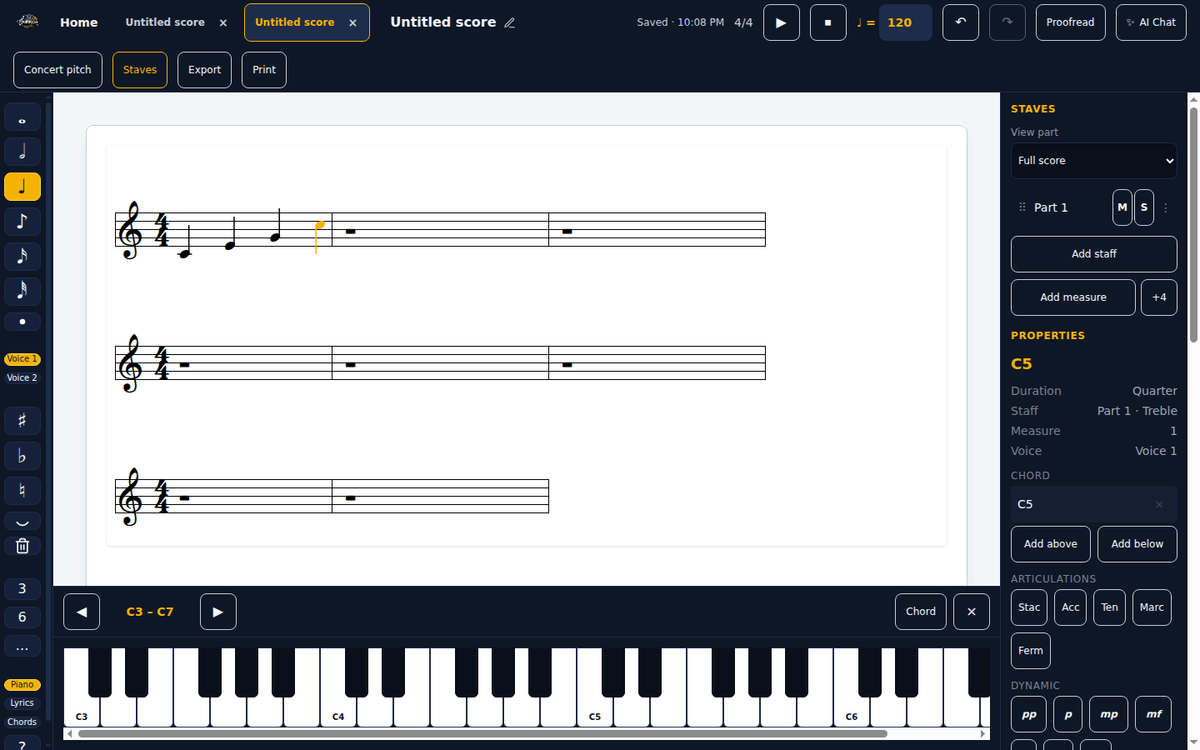
The narrow strip down the left of the editor is the note palette. Pick a duration there, then place notes on the staff. Everything in the palette is a toggle: what you picked stays picked until you pick something else.
- Place a note
- Tap or click the staff where you want it. On a tablet, drag from the palette onto the staff. The note goes in at the duration currently selected.
- Rests are automatic
- Rests fill automatically — place notes, and StaffWeaver keeps every measure complete.
- The piano drawer
- The Piano input button opens a slide-up keyboard. Tap keys to enter pitches, shift octaves, and switch on chord mode to build a chord before committing it. Each key you press sounds as you press it.
- Ties and dots
- The augmentation dot extends the selected note by half its value again. Tie to next note joins two notes of the same pitch into one sounding note.
- Tuplets
- Triplet and Sextuplet are one tap. Custom opens an actual-against-normal entry — “7 in the space of 4” and so on — and Remove tuplet puts the passage back.

Note durations in the palette
- Whole
- Half
- Quarter
- Eighth
- Sixteenth
- Thirty-second
Accidentals
- Sharp
- Flat
- Natural
Tuplet shortcuts
- Triplet — 3 in the space of 2
- Sextuplet — 6 in the space of 4
Shaping a note
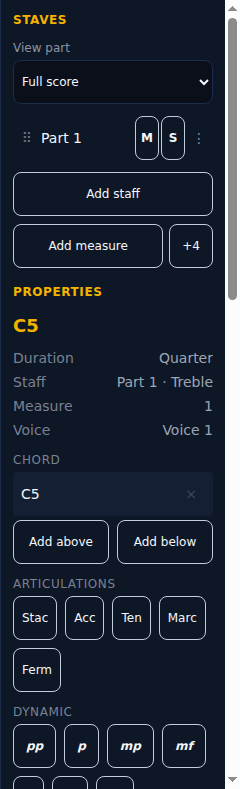
Select a note and the properties panel on the right applies to it. Articulations stack; a dynamic replaces whatever was there.
- Articulations
- These are multi-select — a note can be both staccato and accented. Tapping a pressed one turns it off.
- Dynamics
- A note carries one dynamic. Tapping a different one replaces it, and tapping the one already set clears it.
- Hairpins
- Crescendo and diminuendo spans are set here, and they are not decoration: playback follows them.
- Accidentals
- Sharp, flat and natural apply to the selected note. The key signature is handled per measure, not per note.
Articulations
- Staccato
- Accent
- Tenuto
- Marcato
- Fermata
Dynamics
- pp
- p
- mp
- mf
- f
- ff
- sf
Measures, keys and repeats
Measure-level settings live in the same right-hand panel, applied to the measure containing the selection.
- Key signature
- Any signature around the circle of fifths, from seven flats to seven sharps. Transposing instruments get their own correctly transposed signature automatically.
- Barlines
- Plain, double, final, and start and end repeats.
- Endings
- First- and second-ending brackets over a repeated section.
- Navigation marks
- D.S., D.C., Coda, Segno and Fine. These are followed during playback, so what you hear is the route a player would actually take.
Lyrics and chord symbols
Both are typed rather than placed, and both appear as you type rather than after you finish.
- Lyrics
- Turn on lyrics entry and type. A space moves to the next note; a hyphen splits a word across notes and draws the hyphen between them; an underscore extends a syllable with a melisma line. Escape leaves lyrics mode.
- Chord symbols
- Chord entry accepts what you would write by hand — Cmaj7, F#m7b5, Bb/D — and places the symbol above the staff on the part that owns it.
- They make room for themselves
- Lyrics push ledger lines and staff spacing out of the way rather than colliding with them, and the lane is reserved while you type so the preview does not jump.
Parts and playback
The staves rail lists every part in the score. It is where a score becomes a set of parts.
- Per-part control
- Mute and solo each part, change its instrument, reorder parts by dragging, and open a part on its own.
- Written or concert pitch
- Each part renders and prints in the pitch its player actually reads. One toggle switches the whole score to concert pitch for the podium.
- Playback
- Space plays and pauses. Tempo is set in the header in quarter notes per minute. Playback follows dynamics, hairpins, repeats and navigation marks.
- Printing
- Printing goes through your browser’s print dialog, using the same layout you see: no blank first page, and no system split across a page break. Single parts print on their own pages.
Proofreading
Two different things share a panel, and only one of them costs anything.
- Structural checks are free
- Repeats, endings and D.S./D.C./Coda/Fine navigation are checked for problems that would break a performance — a repeat with nowhere to go, an ending with no repeat. Every finding clicks through to the bar it is about. This costs no credits, on any plan.
- The AI second opinion costs credits
- Asking for an AI review looks at voice leading, instrument range, note spelling and engraving. Its findings are opinions, not rules — a suggestion here can be confidently wrong, so check it against the score before you act on it. It runs only when you ask for it, and it is charged in AI credits. If the model fails, the credits are returned.
- Size limits
- AI proofreading takes scores up to 24 parts and 200 measures. Past that it declines before charging you anything.
AI chat and scanning
Both run on AI credits. Neither is required to use the editor, and both tell you what they are about to cost.
- Write a score from a prompt
- AI Score Chat can create a whole score from a description — instrumentation, key, time signature and notes — and then keep editing it conversationally. It edits existing scores too.
- Scanning is a first draft, not a transcription
- Upload a PDF, PNG or JPEG and scanning produces an editable draft. Stated plainly: a mean F1 of 0.34 on real published lead sheets, and 0.825 pooled on our synthetic corpus. Treat it as a head start on retyping.
- Review Mode is where a scan becomes usable
- It puts the scan beside the original page and walks you through it measure by measure, with one-click fixes and per-measure AI assist. The repair loop is the point — a scan is not meant to be accepted as-is.
- Credits
- Premium includes credits every month; anyone can buy a Cloud Pass subscription or a one-time pack. Composing, playback, printing, MusicXML import and export, and the structural Proofread checks never cost credits.
Getting music in and out
MusicXML is the way in and the way out, and it is free on every plan — your work is never locked in here.
- Import
- MusicXML files (.xml, .musicxml, and compressed .mxl) up to 5 MB. Part-group brackets and braces come across with the score.
- Export
- Export writes MusicXML (.musicxml or .mxl) in your browser, free and instantly. Before a download it names anything that particular score would lose in the format.
- What we do not export
- MusicXML only. There is no MIDI export, no audio export and no PDF export — for a PDF, print and choose your system’s save-as-PDF option.
- Tabs
- Several scores can be open at once along the top of the editor, and they survive a reload.
Keyboard shortcuts
The editor is fully keyboard operable — every palette tool, tab and panel control is reachable by Tab and activated with Enter or Space.
- Space
- Play or pause. Ignored while you are typing in a field, or when a button, tab or checkbox has focus — there, Space activates that control instead.
- Ctrl / Cmd + Z
- Undo.
- Ctrl / Cmd + Shift + Z
- Redo.
- Ctrl / Cmd + Y
- Redo, the Windows spelling of the same thing.
- ← / →
- Move the selection to the previous or next note.
- Delete / Backspace
- Delete the selected note. The rest that replaces it keeps the measure complete.
- Escape
- Leave lyrics entry and return to normal note editing.
Still stuck?
If something here does not match what you are seeing, that is a bug in one of the two and we would like to know. Otherwise, the fastest way to learn the editor is to open a score and put a few notes in it.